August 16, 2011

Sizing with Incomplete Information

Some teams that I work with that are new to agile struggle to size their first big agile release. The team is often still trying to gel, assimilate new members, and increase their velocity while spending lots of time creating, understanding and refining the product backlog. One of the challenges they face is learning to estimate with imperfect and incomplete information. How quickly they adapt seems to depend on what they are presented with during their 1st agile/relative estimating session.

Some teams new to agile start with a new project and need to estimate the whole thing with little info, perhaps during a "sprint 0". Those teams are forced to deal with ambiguity right from the start. From then on they accept that they'll have to estimate fuzzy stories. This helps them accept that stories will change, both the details of individual stories as well as what stories make up the backlog. Sometimes revealed detail changes an estimate (up or down). Sometimes it doesn't. But that's life and we can deal with that quite well on an agile project. More on that in a moment.

Other teams I work with already have a project well underway. They have a product in maintenance when they go agile. They've got lots of small and well understood stories. Or if they aren't well understood, they can get that way quickly. The 1st stories they estimate are detailed and certain. But a day will come when the team is forced to estimate some new release or some new product with less than full information. That can be frightening. As these estimates are recorded, we can note that the estimates were made with less info and certainty, but that seldom provides much comfort to this type of team.

However, what you'll find (on a healthy team) is that:

  • Large estimates on the larger stories tend to drive the Product Owner to decompose those behemoths and then ask for new estimates.
  • The team is allowed and even encouraged to revise the estimates (up or down) as more information is revealed.
  • Many of the estimates will not need to be revised. Any additional detail or certainty often doesn't affect the estimate after all.
  • Consistency is good, but accuracy and precision are not necessary. Wrong estimates have an offsetting impact on velocity. That's the beauty of using relative estimates and the empirically measured velocity to compute a release end-date -- an incorrect increase in one gives an offsetting decrease in the other.
  • There will be details that are overlooked. Developers tend to be optimistic with estimates. But that too will soon be taken into account in the velocity (unless you implement all the well understood stories 1st and always save the others for later). (Do note, however, that the shorter your release is the shorter your iterations need to be in order for a change in velocity to be noticed in time.)
  • And management will heed the warning signs when presented with the estimates and velocity and not pressure the team into short-cutting craftsmanship, quality or sustainable pace. (Remember that I said /healthy/ team.)

Seeing is believing

On the second type of team this learning happens slowly. You can have a conversation around these things to try to speed up the learning or to provide some comfort. It's certainly worth trying. But don't be surprised if your convincing arguments are met with disbelief.

June 2, 2011

Engineering Practices Necessary for Scrum

Atlanta has a wonderful tech community. User groups abound. We even have three different agile user groups that meet each month (or more than that if you count the craftsmanship meetup as an agile group and SPIN as partly so). Earlier this year Semeer Bendre asked on twitter why we have these different communities, copying Mike Cottmeyer, Dennis Stevens and I. I tweeted back that #atlantascrum tends to focus more on #scrum whereas #agileatlanta is more free to cover other stuff, such as dev practices. Mike Cottmeyer quickly corrected me, saying they cover fundamentally the same material and XP isn't oob at #scrumatlanta. Then to prove his point, to show just how wrong I was, Mike signed me up to do a talk at #atlantascrum on "Exploring the Engineering Practices Necessary for Scrum." (Let that be a warning to you to tweet wisely.) This blog post came out of that talk. It's pretty much what I said, edited some for this format.

If I have any bias concerning this topic it is that I'm a long-time strong believer in eXtreme Programming. Heck, I was agile when agile wasn't cool. In fact, it wasn't even called agile yet back then. We founded XP Atlanta before the manifesto meeting in Snowbird. And back in 2000 my team gave me a red cape with a big XP on the back. It wasn't until later that I realized that they thought of me more as a super-villain than a super-hero. They wanted me to wear the cape so they could see me coming. And hear me when I made the swooshing noises. But I digress.

I'm otherwise fairly balanced with half my career using a plan driven approach and the later half using an agile approach; and most of my career as a programmer but more than several years in management and product management.

ENGINEERING PRACTICES IN XP

So, first, before we look at Scrum, let's look at the engineering practices in XP. This is the briefest of summaries of these practices.

As an aside, the non-programmers on our teams need to understand and appreciate what this stuff is. Be kind and explain it to them in a way they can understand. Offer them a non-technical, or at least very lightly technical, lunch and learn. This will help us all work together in harmony.

Pair Programming is far more than continuous code review. The pair is thinking on multiple levels: one about the low-level details, names, indentation and syntax while the other is thinking about the big picture, whether this test is sufficient, whether it's the right test, what's the next step, about the next refactoring, and may be helping look up something in the language or API docs. Pairing improves quality and speed of development, or it at least increases the longevity of the codebase by holding entropy at bay. Pairing supports simple design and helps enforce the use of these other practices (peer pressure).

If you are just watching the other guy code, you aren't pairing. Pairing is active. Who has the keyboard should change every minute or three. Try using the ping-pong technique whereby one programmer codes a failing test. The other programmer then makes that test pass and codes the next failing test. Then the first programmer takes over again, and so forth.

Test-Driven Development is where a test (that fails) is coded before the production code (that makes the test pass) is written. TDD supports Refactoring and Collective Code Ownership and Continuous Integration and other things like small releases and iterative development. Out of doing TDD you get automated unit tests for all code. (Or automated acceptance tests for all stories for ATDD.) A related technique is to write an automated test to reveal a defect before the defect is addressed.

Continuous Integration is where you integrate changes daily and preferably much more often. The opposite, of course, is leaving integration until later, which is often a tedious, lengthy, buggy and painful process. A student of lean will learn that leaving integration for later will lessen the likelihood of good luck. Or, delay causes waste.

Refactoring is improving the design without changing the functionality. Many don't do this right or well. It's best done "in the small" all the time, not in large steps and infrequent. The later may be design change, but I'm loathe to call it refactoring. Good examples are small things like rename class, extract method, move method, introduce variable, etc. Most of these common refactorings are supported by the IDEs we use today, such as Eclipse, Intellij, and VisualStudio with Resharper. Proper Refactoring supports simple design and testing.

Coding Standards supports Pairing and Collective Code Ownership. I don't recommend writing your own. There are many published coding standards. I suggest adopting one of those.

Collective Code Ownership is where everyone on the team is responsible for that team's code. All team members may change all the code. We're assuming we have a small team (or teams) of 7 +/- 3 coders. This practice reduces delay (waiting/blocks) and risk. For this, you need pairing and tests.

Simple design -- It's simple design, not simplistic design. Simple design makes code understandable and therefore more maintainable and modifiable.

System Metaphor is a story that everyone can tell about how the system works. This usually yields a system of names. It supports Collective Code Ownership and Simple Design.

So, that's just the XP engineering practices, not all of XP's practices. And that's about XP. That's not about Scrum.

BACK TO SCRUM

But the topic proposed for Atlanta Scrum group was "Exploring the Engineering Practices Necessary to Support Scrum".

So let's get around to that, but before we do, let me take one more detour. If I wanted to find a definition of agile on the internet, where might I look? I'd look on Wikipedia: http://en.wikipedia.org/wiki/Agile_development

Lo and behold, a definition of agile. And, there's a picture of Sutherland. I'm a little miffed that Scrum gets top billing, but at least if I page down, I see a picture of a couple pair-programmers practicing XP.

Now, what are agile engineering practices? I've shown you the XP ones above. What are the 'Scrum' or 'agile' engineering practices? Can't I find that on wikipedia too? Not as of today, but it was suggested to me during my talk that I should fix that.

My point here is that there is no commonly accepted definition of what the agile engineering practices should be, at least not well enough to make it to wikipedia. I say all that to point out that the stuff written below is more of my opinion than are the facts about XP I've stated above.

ENGINEERING PRACTICES NECESSARY FOR SCRUM

What are the engineering practices necessary to support scrum? Go ahead. Write them down. I'll wait.

That's a nice list you have there, but does Scrum make them necessary? Are they necessary because you are doing Scrum? Is it specific to Scrum or is it agile in general? Here's my list of engineering practices necessary to support Scrum:

  • none

I categorically say no to all the practices on your list. None. There are no engineering practices necessary to support Scrum.

The question is a non-starter for me. And I say that as an XP fan, a process that believes in the importance of a specific set of engineering practices. I take exception on two grounds. The first is the word necessary.

Necessary is a bit of a strong word. It's kind of like saying always or never. You never take out the trash. You always make me walk the dog. You never put your dirty clothes in the hamper. You always leave the car on empty. You never say you love me any more. Things like that.

The second is the assumption that if you are doing Scrum you must also be involved in software development somehow. You might not be engineering anything at all.

Lots have blogged on this and there was a good debate on twitter about it (involving Jeffries or Shalloway or Sutherland or Schwaber?). It was about Scrum being sufficient or whether it needs development practices. One side said Scrum by itself is insufficient. The other said Scrum is what it is, it's fine as defined, please do use engineering practices, but Scrum doesn't need to be changed.

My wife runs our household using scrum. She's not the housewife, homemaker, domestic engineer: She's the product owner. (My 13 year old daughter who is made to clean the bathrooms is the scum master. But that's another story.) The point is, there are no engineering practices needed for Scrum to be useful in a household.

A team I once coached was the payroll department. They weren't engineering anything. They were building nothing. But they had initiatives and duties that they managed using Scrum. No engineering practices needed.

Pillar's recruiting team uses an agile approach. Pillar's on-boarding process uses an agile approach. Pillar's management uses an agile approach to manage our internal process improvement initiatives. These don't need engineering practices.

However, I know what you mean. I understand the real question. Maybe this is the question to ask:

When you are doing software development and Scrum, are there engineering practices that help?

Now you can bring out your list again.

But does Scrum make them necessary? Or are they universally necessary when doing software development in the current set of popular high level programming languages, namely Java and C# and Ruby? For the most part, I'd say universally helpful. So, we should scratch Scrum from that question and state it thusly:

Are there engineering practices that help if you happen to be on a project involving computer programming?

Absolutely.

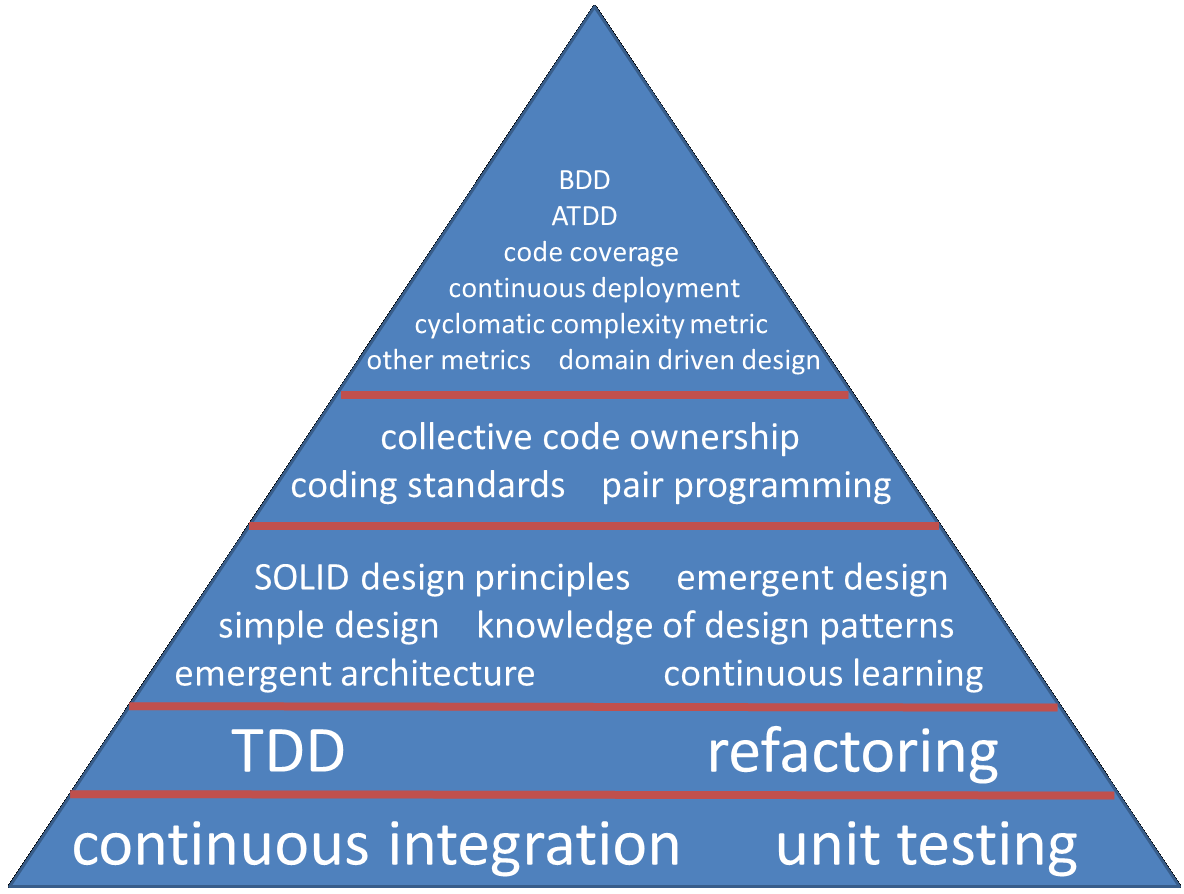
Given that, here's my ordered list of useful software engineering practices. I am representing these as tiers upon which the more basic and most important are the foundation upon which the others are built.


FIRST TIER

Starting at the bottom, we have Continuous Integration and Automated Unit Testing. You get a lot out of this. It can hook most people, being a gateway drug, I mean, can help most people and it's a great place to start. Everything else is harder without this

I didn't list source code control, because, everyone does that now, right? I guess there are some things I just assume, and that's one of them.

I could put pairing in the bottom and that would make the other things more likely, but the rest could happen without pairing, so that is later. Besides, the business reality is that it's hard to find enough pair-programmers, so I'm resigned to think that I'll often have a non-pairing team somewhere in my organization.

Similarly, TDD makes sure UTs, refactoring, and emergent-design happen and has other advantages. But you canunit test without TDD, so TDD is higher up in my list.

How about sustainable pace? Is that a technical practice? I'm thinking it's more of a (project) management practice than a strictly technical practice. Otherwise, I'd stick it here.

SECOND TIER

You need tests before refactoring. Some would argue that you need refactoring to do automated testing. Lots of truth to that, but strictly speaking, you could test without refactoring. But you need TDD and Refactoring to support Tier Three.

THIRD TIER

In this tier is Simple Design. Simple is hard. To make things simple, you have to be quite knowledgeable about numerous design concepts. And you also need to be just plain good. You have to be knowledgeable in areas that can make your designs anything but simple if misused, which is why I said you also have to be 'just plain good' in addition to knowledgeable.

Also in this tier is Knowledge of Design Patterns. I didn't say use of design patterns. Use them in your conversations as shorthand, for a concise, rich with meaning way of communicating. But use them in your code carefully.

You should know SOLID design principles if your system is object oriented.

Emergent Design and Emergent Architecture is about recognizing the fact that we aren't going to get it right the first time. Let the design emerge/evolve over time as we learn. Even very very smart folks, the top folks in this field say they don't get it right the 1st time. (Seems like I should try to give a reference to that. Eh, I'll just put an unsubstantiated claim that I bet Cunningham, Jeffries, Uncle Bob, Joshua Kerievsky, Kent Beck, Corey Hanes, and may others would agree.)

This tier is really all supported with 'Ongoing Education', continuous learning. I really think there's lots to learn there and the field continues to grow. This is so difficult to do really really well, that we can never stop learning.

FOURTH TIER

Collective Code Ownership and Pair Programming require a Coding Standard.

As I mentioned earlier, Pair Programming is really a foundational technique, but I can't say that it's for everyone. I'm a strong believer in the technique and have required most of my employees give it a try for at least a month, though it can take two or three to really get accustomed to the approach.

FIFTH TIER

This is the just good old good to know tier. In here are some things that may change or be replaced by something else over time, more so than the ones in the other layers. This tier also includes things to have in your tool box, though you may never pull them out to use them:
  • Code Coverage
  • Cyclomatic Complexity
  • Other Code Metrics
  • BDD
  • ATDD
  • Domain Driven Design

Some might argue with me for putting ATDD or maybe BDD so high up. There are numerous techniques for automated testing at a higher level than unit testing that teams can choose from. I didn't want to list them all and I didn't want to say that one was better than others in all cases.

Likewise, Domain Driven Design is a useful technique, but I can't say every team must use that technique over another.

BACK TO SCRUM

Is there anything in Scrum that should lead us to do these things? You need these things to be agile software development team and these things support time boxed iterations. But there is also the Definition of Done. Some Scrum teams define what done means and hopefully it includes explicitly or implicitly some of these things.

After my talk at Atlanta Scrum on this topic last week I gave a demonstration/explanation of TDD. Surprisingly, I got more positive feedback about that than I did the presentation. Not that either was stellar, but I was expecting a different crowd than what showed up.

Contact me for a TDD demonstration or agile lunch-n-learn at your office.

February 23, 2011

Comprehensive Documentation - Bad Assumptions

Agile is easy to dismiss. Many people hear something that doesn't sound right, something that sounds different than what they are accustomed to, and they develop misconceptions. They share their misconceptions with others. They dismiss agile without any more thought. A common misconception concerns documentation.

This came across my inbox recently:

I spoke to …, and he doesn’t have a requirement for Agile. He is familiar with the methodology, and his concern is comprehensive documentation. He believes that is a critical part of development that becomes less critical with the Agile methodology.  If his assumptions are incorrect, please let me know.

Are his assumptions incorrect? There are likely a lot of assumptions in that short statement:
  • "Comprehensive documentation is a critical part of development." That may be true for his project. But it is not true for many projects. If he assumes that comprehensive documentation is too critical to do without on any project, his assumption is incorrect.
  • "Comprehensive documentation becomes less critical with the Agile methodology." Often this is true. But that's a good thing. So, he's probably concerned about this…
  • If he assumes you can't write comprehensive documentation on agile projects, his assumption is incorrect.
    You can write all the documentation you want.

Comprehensive Documentation


Agile simply warns against using documentation as a measure of progress. Instead, agile favors working software as a measure of progress. If comprehensive documentation helps you get to working software, or adds value after the software is written, then create comprehensive documentation. If you have a regulatory environment you can't get around, then meet your regulatory requirements, but be creative and try to find an automated approach to generating it. If we're talking end user documentation and you can't make your application usable without end-user documentation, then write end-user documentation. If we're talking about installation instructions, agile favors automation, but if you can't automate and can't make it easy, then document it. If you have published APIs, create them with great care, provide great documentation and treat them as contracts.

If we're talking about requirements specifications, agile prefers requirements documentation in the form of user stories, constant collaboration between the givers of the requirements and the implementers of the requirements, and automated story tests. If you aren't there yet, if you don't know how to do that yet, then keep writing requirements documents for now, and strive for continuous learning and continuous improvement.

If we're talking about comprehensive technical documentation of the implementation, agile favors the software craftsmanship approach of refactoring towards small methods with very clear and descriptive method, variable, and class names. This leads to readable and self-documenting code. Agile also favors high code coverage through automated unit tests, which documents how to use the implementation and the intent of it.

Every instance of agile is unique. Each adoption of agile must be tailored for the context in which it will live -- the organization.

Usually, however, comprehensive documentation is waste. If the documentation doesn't match the source code, the documentation is wrong. Documentation is almost always wrong. Using misleading documentation is wasteful. Maintaining documentation is expensive and it rarely achieves a defect free state. More waste.

At the very least, this person shouldn't throw the baby out with the bath water. A lot of value remains in agile even if he disagrees with its warnings about documentation. I'm not saying that agile is suitable in his environment -- it in fact might not be. He may have no change or uncertainty in his environment. He may have a very repeatable and predictable situation, ideally suited for a plan driven approach.


In any event, this person is most assuredly concerned about how something will be handled, be it support (handled by pair-programming and a coded test suite) or design (handled by design-all-the-time, pair-programming, test suite, refactoring) or coordination (handled by collaborative space, published and documented APIs as contracts), or etc... I could assuage his fears if I new what was underlying them. That would require a face to face conversation. I'd welcome that opportunity. With him, or with any of you, my readers, or with any of your colleagues. My email address and phone number are noted at the top of my blog. Contact me at any time.

February 22, 2011

Scrum Fundamental: Planning and Iterating

This is my last post, for now, in this series on common issues teams have with fundamental Scrum concepts. Here are a few tips, reminders actually, for planning and iterating.

Make story estimates visible to the Product Owner. Understanding the relative costs of features helps make better trade-offs.

Product Owners reprioritize work not started. Always work on the highest value story and risk reduction stories first.

Plan a second release from the start. This takes the pressure off. “We’ve just got to have feature X!” becomes “ok, we’ll put feature X in the second release and not worry about it now.” You may never do feature X, or release two, but it helps the first release move along unhindered.

If you need to know when you’ll be done, make a build up chart for the release. See Alistair Cockburn’s article on this topic.

Minimize the amount of work in process (WIP). Limit this in two ways: In each iteration, have the whole team work on just a few stories (like, three to six, depending on size). I put some rules of thumb on this in an earlier post. Don’t start work on something that cannot be completed in the iteration. With traditional project management using Gantt charts, you identify and care for the critical path. With agile projects, you limit WIP and increase cross-training, teamwork, team goals and collaboration to care for the critical path.

In addition to limiting the number of stories in the iteration, limit how many stories can be in progress at any one time. Limiting WIP to, say, one-third of the number of stories committed to the iteration might be about right. Then work towards limiting it to just one.

That’s it for now. But there is so much more that can be said. I welcome your own thoughts and lists and links to other relevant information in the comments below.

February 16, 2011

Scrum Fundamental: Communication, Delegation

I’ve been blogging lately on common issues in teams practicing Scrum or otherwise trying to be agile, and not having complete success. Yesterday's post covered a hodgepodge of items very loosely related to measuring progress. Last week's post covered user stories. Today I thought I’d talk about communication and delegation.

Communication

The purpose of the daily stand-up/scrum is communication. This is very important. The idea is to keep the meeting short (so make everyone stand) and have everyone share just the info that most everyone else needs to know. This can often be done in five or ten minutes.

Some teams cover what they did yesterday, what they plan to do today and roadblocks. It’s useful to mention some significant change that they are about to commit to source control.

Teams that are co-located and that pair-program with collective code ownership and limited Work In Process don’t typically need to discuss those topics because everyone already knows what everyone else is working on. Those teams just talk about less about what they are doing and more about their impediments – things that are slowing them down.

Decide what is most important for your situation. Whatever your standard topic is, don’t go into much detail or resolve anything during the meeting. Those that need to follow-up or work together or have a deeper discussion get together afterwards.

Whatever your standard topic is, vary it. Don’t get stuck in a rut. If you usually go in order by person, once in a while go in order by story. Throw in a different question to answer, perhaps related to something you are trying to improve upon identified in a retrospective.


The standup is a start, but don’t stop there. Stop using email. Get out of your seat and speak to someone face to face. And working with the whole team in an open space is a really really really good idea.

Delegation

Let go of assigning tasks to people. Let the team manage task assignment themselves. People will choose the correct tasks most of the time. When they don’t, let that be a learning experience.

Let the team estimate the stories.

Let the team come up with the tasks.

Make time for yourself. Take time to think about and to improve the system. By ‘system’ I’m referring to the process and the organization, not the software you are developing.

Next

Next up should be a post on planning.

What is on your short list of common problems related to some fundamental aspect of Scrum?

February 15, 2011

Scrum Fundamental: Measures of Progress

In my user stories blog post last week I claimed that problems on Scrum teams are often due to lack of knowledge about a Scrum fundamental. Today I’ll tackle the next item in my short-list of common problem areas:
  • measures of progress,
  • delivering value,
  • demos,
  • getting feedback,
  • keeping it working,
  • continuous integration,
  • and testing.
Yeah, so, that’s more than one item, but one kind of leads to the next.

Requirements and Design

One way, the traditional way, to try to build trust and understanding between a development team and the business or client is to spend a lot of time on designs, analysis, and wirefames. The problem is that it’s difficult to predict the future with much accuracy. You will likely miss details and misunderstand how the app will be used in practice. Requirements and priorities will change.

The agile prescription, therefore, is to not spend much time figuring out details for some story that you may never implement or that may change drastically in the ensuing months. Understand the stories at a high level. Get into development and begin delivering working software as soon as possible. Get feedback sooner and begin reaping the benefits of the software sooner.

Defer any decision and any work that can be deferred. You’ll be smarter next month, you’ll understand the system and the requirements better. Let the design speak to you, refactoring as you go.

This would be a good place to say something about lean and systems thinking and Pillar Technology’s “Business value over working software” appendage to the Agile Manifesto and about not building software when it would be better to redesign the system, without IT, then automate what makes sense. But that’s another whole post.

One good thing about working software is that you can have demos.

Demos

Favor demos over status reports. After completing each small story, demo it at least internally. Get to where you can have frequent (weekly or bi-weekly) demos to your clients/users. That early feedback is very important. This also holds staff accountable for quality, for “keep it working”, and for getting to done.

The demo isn’t for the Product Owner. Your Product Owner should have been involved with the team while the story was being implemented. Your Product Owner should have seen the story before the demo. There was an interesting discussion on the Agilistas LinkedIn group about who should do the demo, and why.

Keep it Working

Employ the “keep it working” principle. Build a usable system early on and keep it working continuously. The source in the version control system must always be usable. Set up an automated build/test process using a tool like CruiseControl, Cruise, or Hudson. Have it inform everyone when the build breaks. You should have a demoable product at all times. At the end of each iteration you should have a shippable product.

This requires automated testing. Pick a level with which to start coding test cases. Most often this is at the lowest level, unit tests. I recommend the xUnit framework or RSpec, but there are other good choices. [Hmmm. I feel compelled to say something about cucumber or BDD, but I intend this to be a fundamentals post. BDD ought to be fundamental, but it isn't as fundamental as this other stuff, particularly if I'm talking about Scrum. Admittedly, this post has left Scrum and is off in generic agile-land. But I digress.]

Sometimes, however, your methods are too large and have too many dependencies to be tested well at this level without first doing much refactoring. In those cases, automate your tests at a higher layer, then refactor and employ unit testing as you go. I’ve used Selenium and Rational Functional Tester for UI-based testing, but there are other choices out there. Working Effectively With Legacy Code by Michael Feathers comes highly recommended.

If you do a good job here, you’ll reduce the amount of manual testing you have to do. You can limit that to usability, break-the-box, and exploratory testing rather than regression testing.

Just a short word about testers. QA professionals think differently and approach testing in ways that developers do not. I like getting QA involved with the developers, pairing. I like getting development involved with anything that QA is taking the lead on automating. And I really like getting QA involved with the Product Owner to help define good stories and good acceptance criteria.

Parting Note

I almost abandoned this series of posts. There’s really nothing new here. I’ve said nothing better than it has been said before. I’ve just said it differently. Sometimes ‘different’ resonates with someone who hadn’t understood the way it was put to them before. So, I’ll press on with these posts. Unless I change my mind.

February 8, 2011

Scrum Fundamental: User Stories

In my line of work as an agile coach I get to help people who are just starting to use Scrum. Some common problems crop up with many of these teams. If often comes down to some Scrum fundamentals. Fundamental doesn’t mean easy. Professional athletes work at the fundamentals and so must we.

If I had a short list of common problem areas, the neglected fundamentals might be: good stories, “keep it working”, getting to done, collaboration, and planning. That’s a bit much for one blog post, so, maybe over the next few days I can address these in a series of posts. Here’s the first.

User Stories


Analysis of a business problem yields features that may either be “stories” or that may be broken down into stories. The first pass will have stories that have some very important parts as well as some less important parts. Identify and implement the most important stories first and address risk first. Defer as much as possible to the end of the project.

That sounds obvious, but it’s so easy for a developer to “just add this in while we’re working in this area.” It’s seductive to the Product Owner to want to “round out” some feature set. So many useless features and dead code gets bought and paid for that way.

Maximize the amount of work not done. Be ruthless in deferring what is less essential until later; you might not ever have to do it. Don’t build frameworks in advance or build support in for features you plan to work on later because You Aren’t Going to Need It – the well known YAGNI principle.

Split Stories


The approach here is to split your stories. The “User Management” story becomes “Add Users”, “Delete Users”, and “Modify Users”. You might never implement Delete, and Modify isn’t needed in the first release. You may further split Add User into basic and wiz-bang versions. This can likely be split further to deal with different types of users, assorted permissions, error cases, cascading, and more complex attributes of the user. After splitting, implement the most valuable stories first, of course.

Each story should have some value to your business/client/customer, particularly to an end-user. Each story should deliver some function from top to bottom. It should be a complete vertical slice through your application. Don’t divide stories along architectural lines. Avoid technical/horizontal slices (the DB framework, the complete object model, all the UI components). For the “user management” story, don’t have a story for the UI and a story for the backend.

Spike Stories


Use spike stories when you need to figure out how to implement or estimate something. A spike is a short time-boxed experiment or research, with a specific objective to address unknowns and risks. The conclusion of a spike may beget more stories and spikes.

Rules of Thumb


Some rules of thumb for story size:
  • One story should not take the whole team more than half the iteration.
  • The team should be able to finish any story in one to two days for a one-week iteration.
  • The team should be able to finish any story in one to four days for a two-week iteration.
  • Aim to have 3 to 8 stories for a one-week iteration.
  • Aim to have 3 to 8 stories for a two-week iteration.
  • If most of your stories can be done by a person in half a day, they are too small.
  • If your team is doing more than 8 stories per iteration, your stories are too small.
  • If your team is doing more than 9 stories in a three-week iteration, your iterations are too big.

Remember, these are just my rules of thumb. There are valid exceptions.

Summary


Poor stories will make Scrum painful. I’m not the first to write about good user stories, not the most eloquent, and won’t be the last. If what I’ve written describes your problem, read more about it or find a good coach. I’m available.

Question for the day

Disagree with my recommendation? Have a better way to word this? Hate my rules of thumb? Have a better blog post on user stories? Post your thoughts or post a link.

February 2, 2011

Scrum Master? Or coach?

I've seen many more open positions for Scrum Masters than I have agile coaches. I've been asked to be a Scrum Master more than I've been asked to be a coach. Is it just marketing? Scrum has market share; it's widely known and understood. Does the market distinguish between a Scrum Master and a coach?

I often find that companies looking for a Scrum Master want someone to run their standups, planning and retrospectives. They want an agile project manager to manage the projects, to report status, to track budget.

They seem to not want the change agent and process improvement aspects of the Scrum Master role. Or, they want a little change agent and process improvement to happen as long as it's directed towards the team and not management. And anything directed toward the team mustn't involve facilities or pair programming. Or HR. Or empowerment.

But isn't that what a Scrum Master is supposed to be, a coach?

I dislike this dichotomy.

There was a recent discussion on the Agile Alliance discussion group on LinkedIn about the career growth path of a Scrum Master. The question was, is there a growth path? I liked Irene Michlin's response:

Have they all brought their teams to "performing" stage? Process is perfect, as in "nothing left to improve" a constant motive in retrospectives?

They are either all very brilliant and need to go and become trainers and coaches, or they don't get what it means to be a Scrum Master.

If there is something left to improve, then your job as a Scrum Master is not done -- you haven't mastered Scrum Mastering. Or, at least you aren't done coaching. But there is that distinction again.

I dislike this distinction between Scrum Master and coach. Unfortunately, I find it useful. It's a tell, as in poker. It helps evaluate an opportunity. It's how the conversation goes. "No, I won't be your Scrum Master, but I'll gladly train your team to handle this role. I'll be your coach. Are you ready for a change agent?" Sigh. I find it useful, therefore I tend to perpetuate the distinction.

What should we do? Not use the term coach and elevate the term Scrum Master? Should we live with it because it is what it is? Once the dichotomy is there it's not possible to kill it. Is there a useful distinction between the two?

January 15, 2011

CAN: Shifting the Voice of the Business to the Team

I've been thinking about Mike Cottmeyer's "12 Keys to Success with Agile", specifically his bullet #3, single voice of the business, where he says "This cannot be shifted to the team..."


It can.

Earlier this week Scott Chacon of GitHub presented his approach to projects, called Developer Driven Development, in a keynote address at CodeMash 2011. I won't try to explain DDD here, since the details aren't germane to this post.

However, key to DDD is that you must have careful hiring practices, careful to the point that you only hire people that already demonstrate a commitment to the project and possess great knowledge of the domain. (My words, not his, but I think he'd agree.) Hire those that are already involved in the project or in related ones. Clearly, to be already involved in the project before you are hired likely implies you are either involved in an open source project or are an actively involved customer or user of the product, be it open source or commercial.

Can that be applied to Corporate America? Not completely sure, but we can certainly apply some lessons. If your team hasn't already caught the vision, you need to help them catch the vision. This is important on any project, agile or not. But its importance is indirectly proportional to the extent to which you have an effective voice for the business involved with the team. That is, the less that the team understands the business need already, the more that vision casting is needed. The more that the team knows the business need own their own, the less involvement the team needs from "the business".

I've been on at least one team of note in Corporate America that the single voice of the business was successfully shifted to the team. In this case the team sold the business on a need. The team was given the leeway to run with the idea. Each person brought to the project what they thought the project needed. Each person on the team had a voice in prioritization. Anything that was to get done had to have the support of the team. (So, this wasn't a free-for-all to the extent that an open source project would be. Everyone did not go off and build whichever feature they wanted. The team agreed to the iteration's backlog.)

This worked because the team wanted it to. We wanted to keep doing what we were doing. We liked the product, the project, the team. To keep it going we had to demonstrate value to the organization that was paying the bills. So, we listened to those using the product and took their needs and suggestions into consideration.

It worked much like the open source model: I build what I want, what is interesting to me. But motivation is multifaceted. I'd like help from others, so I have to consider their interests. I'd like my product to be useful, to be used. I'd enjoy a little fame or appreciation from others. I'd like enough money out of the project to take money off the table. So if I'm relying on the product to pay the bills or support my multifaceted motivation, then I'm going to listen to my users and supporters.

It's going too far to say that you cannot shift "single voice of the business" to the team. A trusting cross functional team with empowered team members sharing accountability who have the vision can BE the single voice of the business.

January 1, 2011

Wearing the Right Hat

A Scrum Product Owner at a client of mine once told me he didn't trust development to build what he wanted built. Sadly, I find this quite common with the more technical POs. The lack of trust was largely due to his negative experience with some other dev team at a different company. His concern was that future value would be blocked by using a simplistic approach now. This PO therefore stepped way over the PO/DEV responsibility line into specifying some of the "how" for a set of stories.

Lack of trust is a significant issue. I could have told the PO that he needs to be able to trust the team. I could have suggested he create opportunity to build that trust, or change the team. Either way, that would take some time and we can work on that. But that's not the focus of this post.

And I could have explained emergent design and the danger of over-architecting things now. I could have told him YAGNI, but have also said that it is okay to share the big-picture vision with the dev team. That it's okay for the dev team to think about where they are headed long term as long as they "pay as you go" and not design and build too much up front. But that's not the focus of this post either.

The focus of this post is that I told him it was okay for him to not trust the developers for now and that it was okay for him to step over the line.

Now, before you take away my Agile Badge, let me explain myself.

product owner hat architect hat
Product Owner Architect

I told the PO that if he is technically capable and can pull it off, then he can AT THE APPROPRIATE TIME review development's planned approach and make suggestions. I told him he can have a PO hat and an architect hat, but that he can only wear one at a time and he needs to wear the correct one at the correct time. He must wear the PO-only hat and only the PO hat during the planning game. Once the business requirement is sized, split, resized, scheduled, and planned, he can visibly remove his PO hat and put on his architect hat during the design and tasking part of the sprint.

In this case, I told him that I believe he is wrong and most likely doesn't need what he was requesting and that what he was requesting will greatly complicate the design and require much much more code than necessary. There was a better approach. Nevertheless, I didn't tell him not to put forth his ideas. For me, it's just a matter of timing.

What would you have done?